In industrial manufacturing, automatic screw feeding machines are widely used on automated assembly lines to efficiently and quickly supply screws to tightening stations. However, due to the complexity of the equipment and high-speed operation, multiple feeding is a common issue. It can lead to screw jams, production line stoppages, decreased product quality, and even equipment damage. Therefore, effectively preventing multiple feeding in automatic screw feeding machines is crucial. This article explores several common technical methods and strategies, and how they can be applied in practice to prevent multiple feeding.
1. Sensor Detection Technology
.png "/uploads/image/2025/11/07/1762500361733049/1 (3).png")
Sensor detection is one of the most common and effective methods to detect the presence of screws and control the feeding action. Here are several commonly used sensor types:
a. Photoelectric Sensors:
Photoelectric sensors detect the arrival of a screw by sensing the interruption or reflection of light. When the light is blocked or reflected by a screw, the sensor sends a signal to the control system to stop the feeding action, thereby preventing multiple feeding.
b. Proximity Switches:
Proximity switches detect the approach or contact of a screw and trigger a signal to stop feeding. These switches are usually based on electromagnetic induction and work well for detecting metal screws.
c. Pressure Sensors:
Pressure sensors detect changes in pressure in the feeding area to identify the arrival of a screw. When a screw contacts the sensor, the increased pressure is detected and a stop signal is sent to halt feeding.
2. Image Recognition Technology
Image recognition uses cameras and image processing algorithms to detect the position and status of screws. This technology typically includes the following steps:
a. Image Acquisition:
A camera captures images of the feeding area.
b. Image Processing:
The acquired images are processed and analyzed to identify the position, orientation, and status of the screws.
c. Object Recognition:
Based on predefined targets, the system determines whether a screw is present and whether feeding should proceed.
Image recognition offers high accuracy and flexibility, and can adapt to screws of different shapes, sizes, and materials. However, due to its complex algorithms and processing requirements, it tends to have higher implementation costs.
3. Optimization of Feeding Mechanism Design
In addition to sensors and image recognition, optimizing the mechanical design of the feeding system is also key to preventing multiple feeding. Here are some design optimization suggestions:
a. Feeding Track Design:
A well-designed feeding track ensures that only one screw is correctly delivered to the assembly position. By adjusting the size and shape of the track, the likelihood of multiple feeding can be reduced.
.png "/uploads/image/2025/11/07/1762500425262301/2 (2).png")
b. Feeder Parameter Adjustment:
Parameters such as feeding speed, force, and duration can be fine-tuned to better control screw supply and stopping.
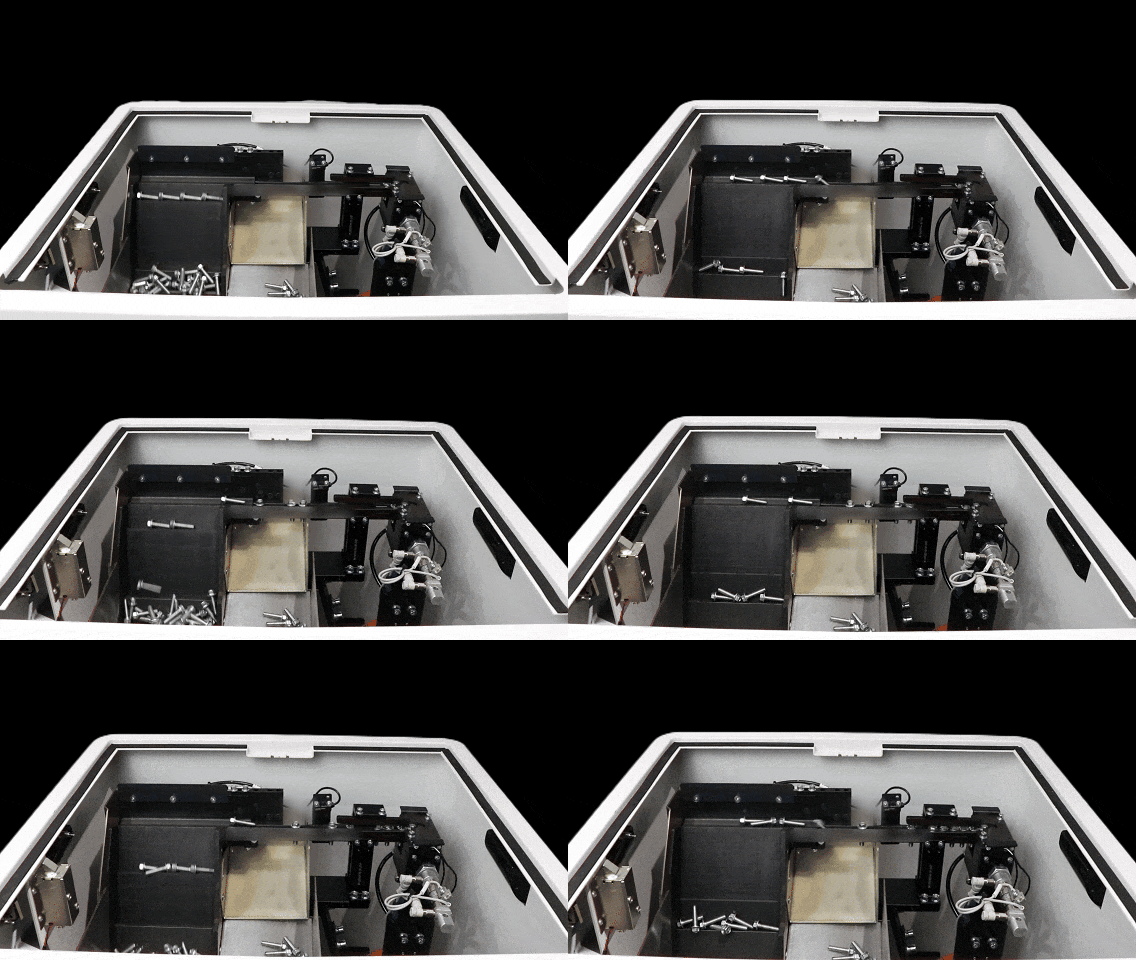
c. Sensitivity Adjustment of Feeding Mechanism:
By adjusting the sensitivity of the feeding mechanism, it can respond more promptly to signals from sensors or image recognition systems, accurately stopping the feeding action.
d. Structural Innovation:
Redesigning or replacing components prone to multiple feeding. For example, Danikorr’s rotary disc automatic screw feeder eliminates the feeding slot entirely, fundamentally preventing multiple feeding. It also achieves zero jamming, ensuring stable feeding and improved production efficiency.

4. Fault Detection and Auto-Recovery
Even with preventive measures, multiple feeding can still occur. Therefore, fault detection and auto-recovery functions are essential for quickly restoring normal operation. Once multiple feeding is detected, the system can facilitate easy troubleshooting and automatically resume feeding after the issue is resolved.
Conclusion:
Preventing multiple feeding in automatic screw feeding machines is a complex but critical technical challenge. Sensor detection, image recognition, mechanical design optimization, and fault detection with auto-recovery are common and effective solutions. By combining these technologies and strategies, multiple feeding can be effectively prevented, improving production line stability and efficiency, reducing costs, and ensuring product quality.