As a pioneer in embodied intelligence, quadruped robots—robotic dogs—have moved from lab concepts to real-world applications. They are now widely deployed in industrial inspection, security patrols, emergency rescue, and consumer entertainment. Their commercial potential is accelerating, but product reliability and durability have become the keys to scaling up. In manufacturing, the tightening quality of every single screw directly affects structural strength, operational stability, and market reputation.
Inside a robotic dog, a large number of precision sensors (IMU, force control), joint motors, and complex cable systems are integrated into an extremely compact structure, making assembly difficult. A complete unit usually contains hundreds of screws ranging from M2 to M8. Any不合格 tightening torque or accidental loosening can cause sensor drift, motor seizure, or even short circuits, creating serious safety hazards.

Assembly Challenges
Complex structure with narrow spaces and special-angle tightening requirements.
Internal PCB boards are fragile and require precise torque control.
In manual stations, screw picking is error-prone; quantity and quality must be strictly tracked, while some stations demand high takt time.
In automatic stations, screws are densely packed, requiring high equipment stability.
Complex structure poses extreme challenges for tightening processes
In mass production, manual stations still handle the majority of screw tightening. Yet the robotic dog’s complex structure demands multiple tightening directions—vertical, lateral, and oblique. Traditional straight-handle tools can no longer cope.
Danikor offers both wired and wireless bent-head sensor tools, allowing operators to maintain a vertical grip while easily performing lateral tightening. The 90° bent head reaches deep into narrow spaces, and the ergonomic handle improves comfort, reduces fatigue, and enhances tightening quality and efficiency, ensuring process consistency across different positions.
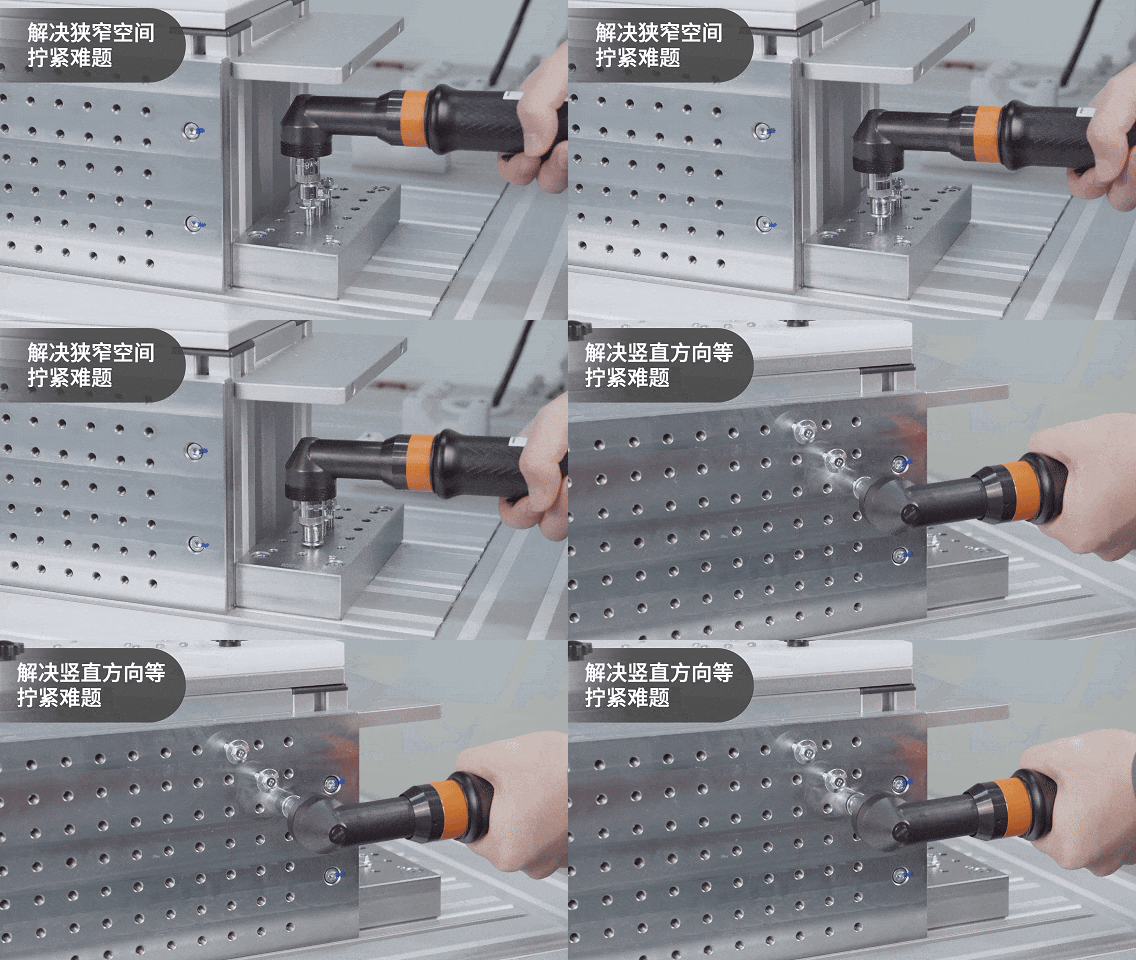
With a 6σ accuracy of ±5 %, the sensor tool delivers high precision, guaranteeing uniform torque on every PCB screw. Real-time data capture and storage enable full traceability of each screw’s tightening status and provide data for subsequent process optimization and quality improvement.
Multi-scenario feeding solutions for manual stations
In manual stations, operators usually pick screws by hand or via blow-feeding, then complete tightening with a handheld module. By optimizing pick tools and introducing assembly-guidance software, we simplify manual steps. Operators only need to follow on-screen prompts to ensure quality and consistency.
Manual feeding: flexible operation, orderly supply
Manual feeding often causes dropped screws, uncontrolled counts, mixed types, and undetected length differences. Danikor’s compact desktop drum feeder supports hand-pick, hand-scoop, and hand-vacuum modes, delivering screws in an orderly way and eliminating common on-site pain points.
.png "/uploads/image/2025/11/24/1763972991699434/640 (1).png")
For larger screws (M5–M10), Danikor’s 1.25 L push-plate counter is small enough for desktop layout. Its dual-push-plate structure feeds screws more stably, supports quantitative dispensing, strictly controls screw count, and includes intelligent empty/full alerts to prevent line stoppages.
.png "/uploads/image/2025/11/24/1763973010612141/640 (2).png")
Blow feeding: high speed, continuous stability
Where higher takt is required, automatic blow-feeding delivers screws to the handheld module; the operator only pulls the trigger to tighten, eliminating pick-and-place motions. This minimizes human error while retaining human flexibility and judgment.
The step-feeder handles M2–M24 screws with lower jam rates, ensuring continuous supply. An integrated cleaning module removes metal debris from screw surfaces, preventing short-circuit risks for delicate PCBA parts.
Automatic stations: making intelligent assembly more efficient
At joints between motors and the body, screw density and assembly requirements are high; fully automatic systems are built. Six-axis robots, tightening modules, and tools integrate to achieve automatic screw feeding and tightening.
Universal tightening modules, selected according to screw length-to-diameter ratio and hole interference, deliver screws automatically and are widely used in automotive and robotics manufacturing, providing reliable guarantees for large-scale, high-standard production.
As a flagship product in quadruped robotics, the robotic dog merges AI and high-end equipment manufacturing, serving as an important carrier of embodied intelligence with broad prospects and rapid growth. Danikor is actively expanding into emerging robotics, already accumulating rich experience in humanoid and industrial robot assembly, committed to delivering smarter, more reliable assembly solutions that help China’s intelligent manufacturing ascend to higher dimensions.